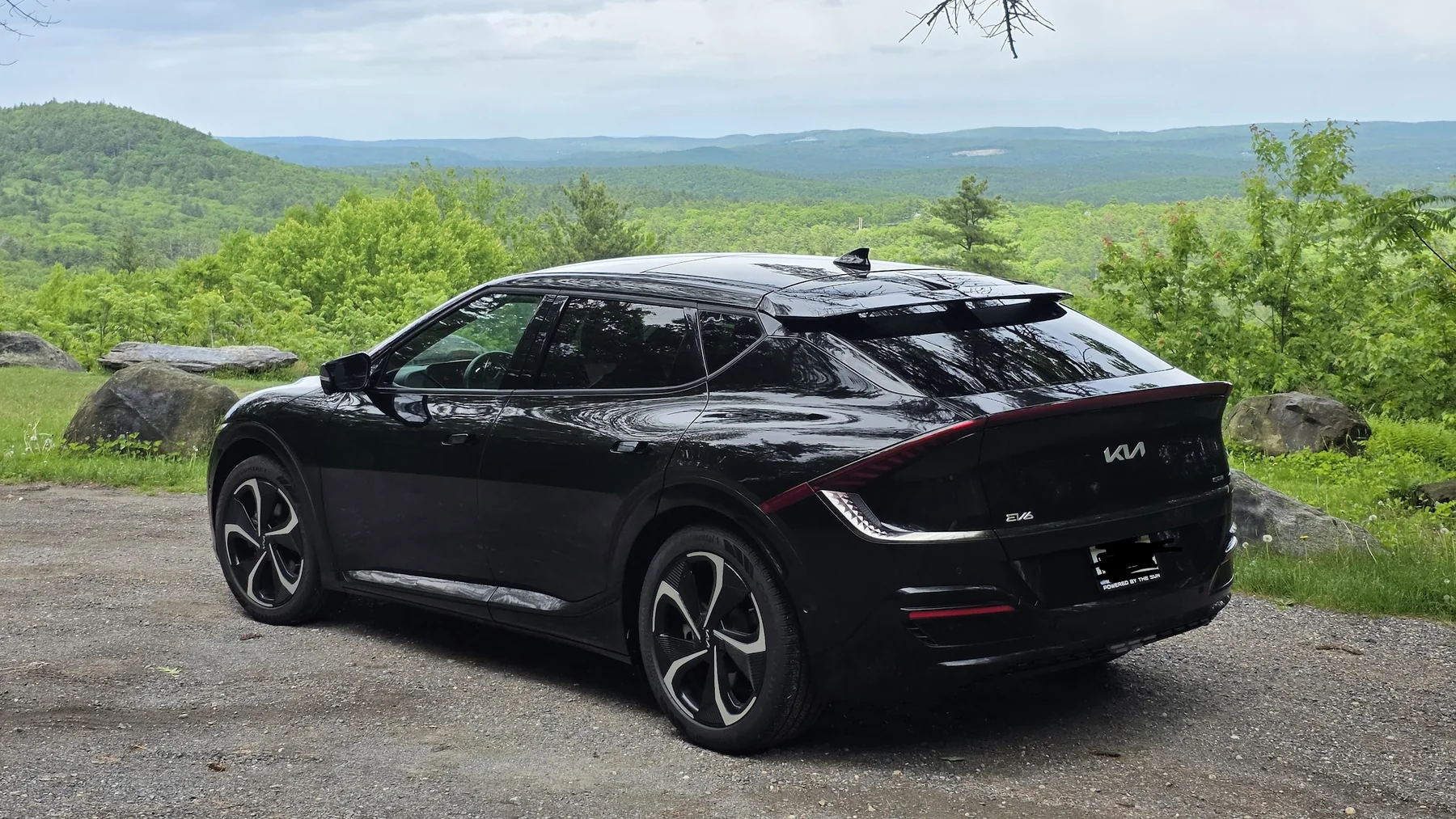
My EV6
A 2023 Kia EV6 GT-Line — examined, diagnosed, and documented
I put this page together mostly for family and friends who might think I've lost my mind. “You went from driving Wranglers with manual transmissions and Dana 44s putting power out to 33-inch KO2s to… an EV6?” Yeah. I did.
If that's a surprise to you, it's because you know I don't usually volunteer my viewpoints unless they come up in conversation or someone asks. Not many of my family or friends are interested in electric vehicles, so it might be news that I've been watching this space for years. After we got solar and I discovered the true wonder of pulling electrons out of the sky, I started looking for other ways I could use that power, and use it more efficiently. Our heat pump dryer is amazing — no scorching of clothes, no concerns about dryer fires, and no vent to pull air out of the house. Our induction range has spoiled me for any other stove — the water's usually boiling before I can assemble my pour-over.
I had also started to follow the EV market, and was keeping an eye out for something that might work for my family, but nothing really checked off every box. Most didn't check off half of them. And then our Subaru got creamed by a couple of deer that couldn't — or wouldn't — adjust their trajectory across a divided highway. USAA would only reimburse us $30 a day for a rental, which at the time only got us an EV. So we tried one. We were supposed to get a Bolt, but when we showed up at the rental place, the Bolt wasn't available. So they handed us the keys to a 2023 EV6 Wind RWD. By the end of the first week, both my wife and I were smitten. Week two, I got a NEMA 6-20 installed off the garage subpanel, picked up a TurboCord on eBay, and we were charging off our solar. For our use case, range didn't end up being an issue. Even at 240V 16A, we'd plug it in below 20% at 7pm when we parked it, and it would be back up to 80% by early morning. That one charge often got us through almost a week. We found we could easily live with the range, charging at home.
That was it. I knew at the next best opportunity, one of our ICE vehicles was toast. And since I'm the only one in the family who can drive the Jeep — six-speed manual — unfortunately, the Wrangler was the one who drew the short straw.
So — this is my 2023 Kia EV6 GT-Line, an all-electric crossover built in South Korea. It has 30,000 miles on it, two electric motors (one driving the front wheels, one driving the rear), and a battery pack that holds enough energy to power an average American home for about two and a half days.
It was purchased in February 2026 as a Certified Pre-Owned vehicle — meaning the manufacturer's dealer (hopefully) inspected it against a 165-point checklist, performed any needed repairs, and backed it with extended warranty coverage before putting it up for sale.
Americans don't want EVs. That's the line, anyway. And honestly? That's precisely why I got a $60,000 car for barely $26,000 — in like-new condition, with 30,000 miles, a tested pristine traction battery pack, and a full Kia-backed CPO warranty. But the deal isn't why I went electric. Here's why:
It's clean and low maintenance. No oil changes, no spark plugs, no timing belts, no exhaust system. Tires, brakes, cabin air filter, coolant checks — that is about it.
It's powered by the sun. I've got solar panels on my roof. The car charges in the garage overnight on electricity my house generated during the day. My fuel cost is effectively zero.
I'm sick of burning liquids for fuel. The section below on gasoline vs. electric efficiency lays out the numbers, and they're damning. A gas car puts maybe 20–25% of its fuel energy to the wheels — the rest is waste heat out the radiator and tailpipe. An EV converts roughly three times as much of its stored energy into motion. Once you see those numbers, you can't unsee them.
And it's smooth. Once you drive an EV, you don't go back. A gas car is a Rube Goldberg machine — fuel injectors spray atomized liquid into cylinders, spark plugs ignite it thousands of times per minute, pistons hammer a crankshaft, a transmission hunts through gears, and after all of that mechanical negotiation, the car finally goes. An electric motor? You press the pedal, and it goes. Instantly. Silently. Every time.
Because it's a hot hatch barely disguised as a responsible family crossover. The first few times I saw one on the road, it looked radical. These days? I think it's one of the few EVs that has really grown into its looks. I think it looks better today than it did when it debuted.
Because in today's dollars, it cost about what my previous car — an almost bare-bones 2012 Jeep Wrangler Sport — cost me eleven years ago when I bought it secondhand with 65,000 miles on it. Both were Certified Pre-Owned. But the Jeep came with a three-month warranty, and that was it.
The Kia? For roughly the same price adjusted for inflation, I got a car with 35,000 fewer miles, a full comprehensive warranty for a year, a basic warranty for three years, a powertrain warranty for ten years or 100,000 miles, and roadside assistance with trip interruption coverage for ten years and unlimited miles.
I'll miss my Jeep Wrangler — I loved that vehicle. But my family doesn't drive stick, and it was time to relieve the family sedan (a 2019 Subaru Forester that now has 125,000 miles on it) of its heavy rotation in the lineup.
And I knew I wanted this car specifically because we had already lived with one. What put it over the top was that experience, and at least partially, the Dynamic interior sound. Yeah, I know… but hear me out. Like most EVs, the EV6 has a feature called Active Sound Design that generates a synthesized tone through the cabin speakers, scaling with throttle input. There are three different ones you can choose, and also a Custom setting that lets you do even a little more fine tuning. I got hooked on the Dynamic setting. Something about it just tickled my brain the right way. Maybe it was growing up on Sci-Fi. Maybe it's just excitement about feeling the instant electric power while hearing that rising electric-stylized hum changing pitch as the smooth acceleration pushes you against the seat.
I was hooked. It felt like the future, it sounded like the future — electrons from the sun going through a cord to make my car go, and it just went, and it hummed happily as it did so.
It also has an 800-volt architecture — the higher voltage means less current for the same power, which means less heat, which means the car can sustain fast charging speeds longer instead of throttling back. In ideal conditions, it charges from 10% to 80% in about 18 minutes. But that speed is conditional, and that brings me to my only real gripe, something that I think could be addressed with a software update, if Hyundai Motor Group wanted?
If you know gasoline engines, the shift to electric is surprisingly simple. Here are the key differences, translated:
| Gasoline Car | This Electric Car |
|---|---|
| Gas tank holds fuel | Battery pack holds electricity — 77.4 kilowatt-hours of energy stored in 192 individual cells, wired together |
| Engine converts fuel to motion via pistons, crankshaft | Electric motors spin directly — no pistons, no crankshaft, no combustion. Just copper coils and magnets. One motor on each axle. |
| Transmission shifts through gears | Single-speed reduction gear — electric motors deliver usable torque from 0 RPM, so no gear changes are needed |
| Alternator charges the 12V battery | DC-DC converter steps the high-voltage pack (766 volts) down to 12 volts for lights, radio, and computers |
| Radiator cools the engine | Liquid cooling loops — separate circuits for the battery, the motors, and the cabin. A heat pump (like a reversible air conditioner) manages it all. |
| Fill up at a gas station | Plug in at home overnight on 240V, or use a highway fast-charger (this car supports up to 800 volts DC — ultrafast) |
| Oil changes, spark plugs, timing belts | Almost none of that. No oil, no spark plugs, no belts, no exhaust. Maintenance is mainly tires, brakes, cabin air filter, and coolant checks. |
So let's talk about how much of the energy you pay for actually moves the car.
A gallon of gasoline contains 33.7 kilowatt-hours of chemical energy. That's a lot of power per gallon. It's why so much of our world is powered by gasoline — it's an extraordinarily energy-dense fuel.
The problem is what happens next. A gasoline engine converts that energy into motion through controlled explosions, pistons, a crankshaft, and a transmission. At every step, energy is lost — mostly as heat. The radiator, the exhaust pipe, and the engine block are all radiating energy you paid for but never used.
| Gasoline Crossover | This EV6 | |
|---|---|---|
| Energy per "tank" | 33.7 kWh per gallon × ~14 gal = ~472 kWh | 77.4 kWh in the battery pack |
| Efficiency (energy → wheels) | 20–25% — the rest is waste heat | 85–90% — minimal losses |
| Energy wasted per fill | ~350 kWh radiated as heat per tank | ~8–12 kWh in electrical losses per charge |
| Energy to travel 100 miles | ~120 kWh of raw gasoline energy (at 28 MPG) | ~35 kWh of electricity (EPA rated) |
| Of that, reaches the wheels | ~27 kWh (~93 kWh wasted) | ~30 kWh (~5 kWh lost) |
| Cost per mile (national avg.) | ~12.5¢/mi ($3.50/gal, 28 MPG) | ~6¢/mi ($0.17/kWh) |
If you still think gas cars are a pretty good idea and hybrids are the new efficient best of both worlds, read that middle column again. To go 100 miles, the gas car burns through 120 kWh of energy, but only ~27 kWh of it actually pushes the car forward. The EV uses 35 kWh total, and ~30 kWh reaches the wheels. The EV does slightly more useful work while consuming less than one-third the total energy.
Put another way: a gasoline car throws away enough heat in a single tank to fully charge this EV's battery four and a half times — enough for over 1,000 miles of driving.
Here's perhaps the most striking number: according to U.S. Department of Energy data, it takes approximately 4–6 kWh of electricity just to refine one gallon of gasoline — pumping crude oil, heating it, cracking it, and processing it into usable fuel, before it ever reaches a gas station.
This car travels about 14–17 miles on that same 4–6 kWh of electricity. So the energy spent merely preparing one gallon of gasoline — before any of it is burned — could move this car roughly half as far as the gallon itself.
Every car has a biography. Here's this one's, reconstructed from factory records, dealer service systems, Carfax reports, a formal repair order, and diagnostic scans:
The day after purchase, every sensor in the car was read using professional diagnostic software connected through the car's diagnostic port. Here's what the data says:
The battery is the most expensive component in any electric car — it's the fuel tank, and it's the single biggest factor in the car's value and longevity. The OBD-II SOH reading reports 100%, but that number stays pinned there until ~5–7% of real capacity is lost. Using the actual energy remaining at a known charge level, this battery is at approximately 97% true state of health — about 3% degradation from new, which is solid for the mileage.
The battery pack contains 192 individual cells, each about the size of a paperback book. Every single one reads 3.98 volts — they are perfectly matched. Think of it like a rowing team of 192 — every rower pulling with exactly the same force. No weak links, no imbalances.
The insulation resistance (1,748 kilohms) means the high-voltage system is properly sealed off from the car's metal body. Anything above 500 is considered good. This reading is excellent.
This is the component that converts the battery's 766 volts down to 12 volts to run the car's lights, computers, locks, and everything else. It also manages all charging — both home charging and fast-charging.
Even though this is an electric car, it still has a traditional small battery — just like the one under the hood of any car you have ever owned. It powers the computers that wake the car up and keep it alive. The original flooded battery was replaced with an Interstate AGM H5 in February 2026 — higher capacity, better cold-weather performance, and a much steadier voltage profile under monitoring.
Brand new Continental CrossContact RX all-season tires were installed during the CPO preparation — a nice bonus, since decent 255/45R20s run $800–1,000 installed. These are OEM-spec, tuned for EVs, with Continental's ContiSilent noise-dampening polyurethane foam bonded inside the tread — which, among other things, helps me hear the Dynamic interior sound better. For snow, the household has a 2019 Subaru Forester on snow-rated Goodyear Assurance WeatherReady2s. The EV6 is fine if we get caught in a storm, but we'll try to be in the Subaru if that's likely. And honestly, the Contis may not last all that long anyway — at least not while everyone in the family is still getting used to the off-the-line novelty of 446 lb-ft of instant torque.
No car is without a weak point, and this one has a known issue that's worth understanding. I have an entire page dedicated to that. This is the TL;DR, more specific to my situation.
ICCU stands for Integrated Charging Control Unit. It's a fluid-cooled sealed aluminum box located beneath the rear seats. It contains two power conversion subsystems:
V2L (Vehicle-to-Load) runs the OBC in reverse to export AC power, but the outlet hardware is a separate module. Charging communication with external chargers is handled by the VCMS (Vehicle Charging Management System), also a separate control module.
Note: DC fast charging (the kind you do at highway chargers) bypasses the ICCU entirely — power goes straight to the battery. The ICCU is primarily involved in home/Level 2 charging and keeping the 12V system alive.
Bundling the OBC and LDC into one sealed unit is elegant engineering, but it creates a single point of failure.
In some cars, a transistor inside the ICCU degrades over time due to a combination of thermal cycling and transient high-voltage stress — confirmed by Kia's own spokesperson. When this component fails, the car can no longer charge its 12V battery, and it will eventually shut down.
Kia claims this affects roughly 1% of vehicles, but independent data from Consumer Reports suggests the actual rate is 2–10% depending on model and model year. Kia has issued two formal recalls (SC302 and SC327) to address it.
This car's ICCU has been serviced twice by Kia dealers:
October 2024 (16,067 miles) — First recall campaign completed at the original dealer in New Hampshire. Software updated.
October 2025 (30,299 miles) — Expanded recall completed during CPO preparation in Connecticut. The ICCU was inspected, no faults were found, and the software was updated again with the latest version. No hardware replacement was needed.
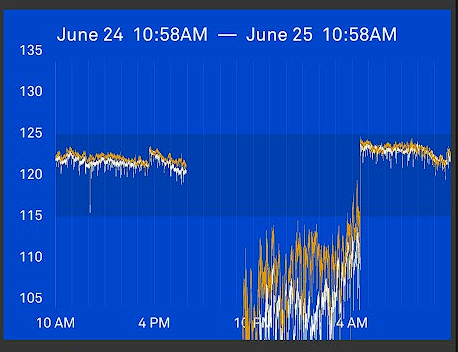
Beyond the manufacturer's fixes, I've specifically designed the home charging environment to minimize stress on this component:
This car carries three layers of warranty coverage. The most expensive components — the battery and electric motors — are covered for another seven years. It's also at least plausible that there will be another recall on this issue, and federally mandated recalls typically require manufacturers to remedy defects free of charge regardless of warranty status — it's not uncommon for recall repairs to be performed well past the original warranty expiration date. As noted in the ICCU Report, at least one owner has reported a recall replacement at 108,000 miles.
| Coverage | What It Covers | Expires |
|---|---|---|
| EV System (Factory) | Motors, battery pack, charging controller (ICCU), power control unit | Dec 2033 or 100,000 miles |
| Basic (Factory) | Drivetrain components, seals, bearings, differentials, drive shafts | Dec 2028 or 60,000 miles |
| CPO Platinum | Comprehensive coverage (most components) | ~Feb 2027 or ~42,500 miles |
| Roadside Assistance | Towing, rental car, travel reimbursement | Dec 2033, unlimited miles |
A final summary of the key data, all from verified sources:
| Metric | Value | Assessment |
|---|---|---|
| Battery health | ~97% true state of health | Excellent |
| Cell balance (192 cells) | 0.00V difference | Perfect |
| Insulation resistance | 1,748 kilohms | Excellent (>500 is good) |
| Charging controller (ICCU) | 14.21V output, 48°F | Healthy |
| Fast charges (lifetime) | 8 | Very low (gentle use) |
| Home charges (lifetime) | 121 | Primary charging method |
| Recalls completed | All applicable — 3 of 3 | All done |
| Active fault codes | 0 | Clean |
| Tires | Brand new (Continental) | New at CPO |
| Cabin air filter | New (replaced at CPO) | Fresh |
| Wiper blades | New (replaced at CPO) | Fresh |
| Warranty (battery/motors) | Through Dec 2033 | 7+ years remaining |
| Home power quality | 120–124V, zero events | Textbook |
OBD-II scan data, cell voltages, thermal readings, warranty line items, and diagnostic detail.